
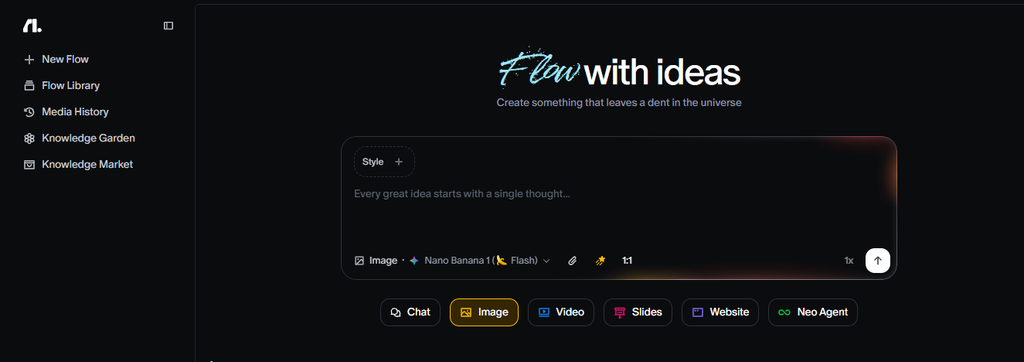
Flowith Agent Neo sits at the center of a broader shift in how people work with generative AI, moving away from the single scrolling chat window and toward software that carries out multi-step assignments on its own. Flowith, the company behind the product, presents Neo as the flagship agent inside its canvas-based workspace. It was introduced publicly in 2025 with a bold claim about handling unlimited steps, context, and tools. Public descriptions of the platform consistently place it among tools for researchers, marketers, freelancers, small agencies, and developers who juggle long projects rather than quick questions. This review looks at Agent Neo as a working product: how it is built, what it produces, how it is priced, and where its limitations appear. The assessment draws on the company’s own positioning along with independent write-ups and listings available in late 2026.
Flowith Workspace Design Behind Agent Neo
Understanding Flowith Agent Neo requires a look at the environment around it. Flowith organizes its workspace as an infinite two-dimensional canvas where prompts, answers, uploaded files, and agent actions appear as nodes that can be moved, linked, and branched. This replaces the linear transcript familiar from most assistants, and it lets a user keep several lines of inquiry open side by side without losing the thread of any of them. Alongside the canvas, Flowith offers a feature called Knowledge Garden, a personal collection of documents and notes intended to give the AI persistent context, and a desktop product named FlowithOS that extends the same idea beyond the browser. Agent Neo operates across these pieces. Instructions can start from a canvas node, material from the knowledge collection can inform a run, and finished outputs return to the canvas for editing. One independent reviewer noted that the canvas can feel disorienting on large projects because the view position is not reliably remembered, a practical annoyance that grows with project size.
How Flowith Agent Neo Plans and Executes Tasks
The way Flowith Agent Neo handles a task is the most distinctive part of the product. A user states an objective in plain language, such as producing a competitive research brief or a slide deck, and a planning layer that Flowith calls Oracle breaks the goal into smaller steps. Neo then calls tools as needed, including web browsing, code execution, file handling, and media generation, and continues working in the cloud rather than depending on an open browser tab. Flowith has described runs that stretch past a thousand steps, which is the practical meaning behind the “infinite” branding. The company also reports roughly ninety percent accuracy on the hardest tier of the GAIA agent benchmark. A vendor-reported figure of that kind is best treated as indicative rather than definitive, since real assignments are messier than test sets.
Flowith Features and Output Range

Beyond planning, Flowith Agent Neo is notable for the range of deliverables it can assemble. Public listings describe support for written reports, presentation slides, website generation, image creation, and video generation, with access to more than forty AI models from different providers, so a user is not locked to a single underlying engine. This multi-model approach matters because different models tend to excel at different tasks, and the platform allows side-by-side comparison on the canvas. Knowledge Garden adds a grounding layer, and one review credited it with reducing fabricated citations when answers are anchored to supplied sources. Neo can therefore function as a research assistant, a content drafting partner, and a light prototyping tool within the same session. The tradeoff is that breadth can blur focus. A single agent producing a deck, a landing page, and a video clip rarely matches a specialist tool in each category, so polished final work usually still needs human review, editing, and brand-specific adjustment before it leaves the workspace.
Flowith Usability and Everyday Access
Usability for Flowith Agent Neo depends largely on how comfortable a person is with spatial interfaces. Newcomers who expect a chat box must learn to think in nodes and branches, and that adjustment takes some practice, although the free tier makes experimentation inexpensive. Access is available through the web application, an iOS app, and the desktop offering, which gives the product reasonable reach across devices. Visible reasoning on the canvas helps users understand what the agent did and intervene when a step goes wrong, which addresses a common complaint about opaque automation. Weak points reported by reviewers include navigation in crowded workspaces and uncertainty about how many credits a given run will consume before it starts. Direct founder access and priority queuing are listed only for the highest plan, so most users should expect standard support channels.
Flowith Plans and Pricing for Agent Neo
Pricing for Flowith Agent Neo follows a credit-based subscription model, and credits are shared across text, image, video, and agent usage. The Starter plan costs nothing and includes a one-time grant of credits, with limited models and no commercial license for generated output. Pro is listed at 19.90 dollars monthly, or 17.91 dollars per month when billed annually at 214.92 dollars a year. Ultimate is listed at 49.90 dollars monthly, or 44.91 dollars per month on annual billing, which totals 538.92 dollars. Infinite, aimed at very heavy users, appears at 499.90 dollars monthly, or about 399.92 dollars per month billed yearly. Commercial licensing begins at Pro, while top-up credit purchases and unlimited-usage packs for selected models are reserved mainly for the upper tiers, so heavy image or video users may find Ultimate the practical starting point. Credits reset monthly on paid plans and do not roll over.
Who Benefits From Flowith Agent Neo

The audience for Flowith Agent Neo is fairly specific. Solo creators, freelancers, small agencies, and independent researchers stand to gain the most, since they often lack the staff to compile research, assemble drafts, and prepare presentation material in parallel. Marketing teams can use the agent for competitor scans, campaign outlines, and content variations, while developers may use it to prototype pages or automate repetitive technical chores. Students and analysts could apply it to literature gathering and structured summaries. People whose needs are mostly short questions and quick rewrites are less likely to benefit, because a conventional assistant is simpler and cheaper for that purpose. Organizations with strict compliance requirements should also look carefully, since public information about enterprise controls is thin and custom integrations and API access are listed as upcoming.
Flowith Market Position Among AI Agents
In the wider market, Flowith Agent Neo competes with a growing field of autonomous agents and multi-model workspaces. Chat-first platforms offer model switching at lower cost, while dedicated agent products emphasize browser automation or coding. Flowith differentiates itself by pairing the agent with a visual canvas, which makes the process legible and editable, and independent commentators have called it one of the more developed attempts at a canvas-driven AI interface. The company reports a user base of around one million, and aggregator scores range from moderate to strongly positive, with one rating of 3.8 out of five and another of 4.7. That spread suggests experiences vary with use case and expectations. For now, Flowith Agent Neo occupies a credible niche for long, research-oriented, multi-format projects, while its credit complexity, navigation limits, and limited published enterprise detail make the free tier a sensible place to start testing.